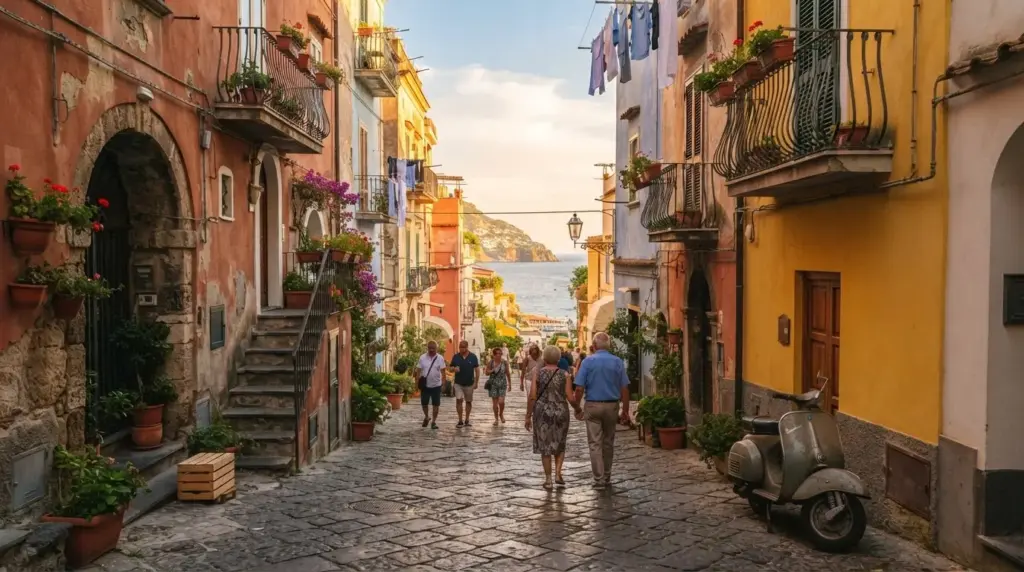
Where to stay in Naples depends on the trip you have in mind. For a first visit, with three days for museums, churches and pizzerias, nothing beats the Centro Storico. For the sea below your window and evenings on the promenade, Chiaia. For quiet and views, Vomero and Posillipo. The city is large and built on hills, and the right neighbourhood saves you hours of travelling.
Below are the areas worth staying in, who each one suits, how to get around and what to know before booking — with a few apartments in every neighbourhood.
At a glance: the right neighbourhood for you
| Neighbourhood | Best for | Metro | Worth knowing |
|---|---|---|---|
| Centro Storico | first visit, exploring on foot | L1 Duomo, Università, Dante · L2 Cavour | lively and noisy at night |
| Toledo and the Spanish Quarter | being in the middle of everything | L1 Toledo, Municipio · L2 Montesanto | steep lanes and steps |
| Chiaia and the seafront | couples, families, sea and aperitivi | L6 Chiaia, San Pasquale · L2 Piazza Amedeo | pricier, parking is hard |
| Vomero | families, quiet stays | L1 Vanvitelli · funiculars | you go up and down by funicular |
| Mergellina and Posillipo | views over the bay, driving | L6 and L2 Mergellina | far from the Centro Storico |
| Stazione Centrale and Garibaldi | day trips to Pompeii and the coast | L1 and L2 Garibaldi | a place you pass through |
Centro Storico: for your first time in Naples
The old centre, a UNESCO World Heritage site, is the Naples people come to see: Spaccanapoli and Via dei Tribunali, San Gregorio Armeno with its nativity-scene workshops, the Duomo, the Cappella Sansevero with the Veiled Christ, and a historic pizzeria on every corner. Almost everything is walkable from here, which makes it the obvious choice for a first trip of three or four days.
The downside: the neighbourhood stays awake late, the lanes are narrow and they get very crowded at weekends and between late November and Epiphany, when San Gregorio Armeno fills up for Christmas. If you are a light sleeper, ask for a room facing the courtyard.

Oasis Flat near San Gregorio Armeno
Show cooking · Oven · Couch · Air conditioning
from €90 per night
Check availability — Oasis Flat near San Gregorio Armeno — apartment in Naples (opens in a new tab)
CasaNa on Christmas Alley
Oven · Couch · Armchair · Air conditioning
from €108 per night
Check availability — CasaNa on Christmas Alley — apartment in Naples (opens in a new tab)
Vico Santa Luciella 20
Oven · Air conditioning · WiFi · No smoking
from €58 per night
Check availability — Vico Santa Luciella 20 — apartment in Naples (opens in a new tab)Toledo and the Spanish Quarter: in the middle of everything
Via Toledo is the shopping street, running from Piazza Dante down to Piazza del Plebiscito: from the old centre to the sea in one walk. Behind it climb the Quartieri Spagnoli, with street food, murals and the little square dedicated to Maradona, a pilgrimage for football fans from around the world. It is the most central area of all, and there is plenty of choice at the lower end of the price range.
Worth knowing: the Quartieri are a grid of steep lanes, often with steps. With heavy luggage or small children, check the floor and whether there is a lift before you book.

La Casa di Famiglia by NapoliApartments
Show cooking · Microwave · Couch · Air conditioning
from €132 per night
Check availability — La Casa di Famiglia by NapoliApartments — apartment in Naples (opens in a new tab)
Toledo Heights by NapoliApartments
Show cooking · Oven · Couch · Air conditioning
from €108 per night
Check availability — Toledo Heights by NapoliApartments — apartment in Naples (opens in a new tab)
Mood Terrace Toledo at Spanish Quarters
Show cooking · Oven · Couch · Air conditioning
from €108 per night
Check availability — Mood Terrace Toledo at Spanish Quarters — apartment in Naples (opens in a new tab)Chiaia and the seafront: the sea inside the city
Chiaia is elegant Naples: Via dei Mille and Piazza dei Martiri for shopping, pedestrian streets, aperitivi in the bars around Via Bisignano and, a few steps away, the Villa Comunale park and the Via Caracciolo seafront, where you can walk all the way to Mergellina. It is the area for couples and families alike: the Villa Comunale, right on the sea, has a playground.
The downside: prices run a little higher than in the centre, parking is close to impossible, and the Centro Storico is a good half-hour on foot, or a metro ride changing at Municipio. This is also where the America’s Cup is raced: in 2027 the Race Village will be on Via Caracciolo.

Hidden Gem on Chiaia pedestrian area
Drying rack · Oven · Microwave · Couch
from €108 per night
Check availability — Hidden Gem on Chiaia pedestrian area — apartment in Naples (opens in a new tab)
Santa Patrizia a Chiaia Apartment
Drying rack · Couch · Air conditioning · WiFi
from €130 per night
Check availability — Santa Patrizia a Chiaia Apartment — apartment in Naples (opens in a new tab)
Riviera di Chiaia 207 - 1° Piano
Oven · Couch · Air conditioning · No smoking
from €85 per night
Check availability — Riviera di Chiaia 207 - 1° Piano — apartment in Naples (opens in a new tab)Vomero: the quiet hill
Vomero is a residential neighbourhood on top of the hill, with wide streets, shops, the pedestrian Via Scarlatti and Via Luca Giordano, and the finest viewpoints over the bay, from Castel Sant’Elmo to the Certosa di San Martino. It suits families and anyone looking for a calm place to come back to in the evening.
To get down into town there is Line 1, from Vanvitelli, and the funiculars: the Centrale arrives on Via Toledo, the Chiaia one at Parco Margherita. The Montesanto funicular has been closed for maintenance since May 2026, for around nine months, and a bus replaces it.

La Favola di San Martino
Drying rack · Oven · Microwave · Couch
from €75 per night
Check availability — La Favola di San Martino — apartment in Naples (opens in a new tab)
Casa MariaPia al Vomero by Napoliapartments
Oven · Couch · Air conditioning · WiFi
from €90 per night
Check availability — Casa MariaPia al Vomero by Napoliapartments — apartment in Naples (opens in a new tab)
Stanzione Classy Flat at Vomero Central
Microwave · Couch · Air conditioning · WiFi
from €108 per night
Check availability — Stanzione Classy Flat at Vomero Central — apartment in Naples (opens in a new tab)Mergellina and Posillipo: the view over the bay
Mergellina is where the seafront ends, with its small harbour and its historic chalet cafés, and it is well connected: both Line 6 and Line 2 stop there. From there the Posillipo hill climbs between villas and terraces above the sea, up to the Parco Virgiliano and the bay of Marechiaro. This is the area for views and quiet.
The downside: Posillipo is far from the Centro Storico and served mainly by buses and the Mergellina funicular. It is one of the few parts of Naples where having a car helps rather than complicates things.

Casa Nostos Piedigrotta
Oven · Couch · Air conditioning · WiFi
from €108 per night
Check availability — Casa Nostos Piedigrotta — apartment in Naples (opens in a new tab)
Casa Petrarca
Oven · Microwave · Couch · Air conditioning
from €120 per night
Check availability — Casa Petrarca — apartment in Naples (opens in a new tab)
Via Posillipo 342
Microwave · Air conditioning · Seaview · No smoking
from €90 per night
Check availability — Via Posillipo 342 — apartment in Naples (opens in a new tab)Stazione Centrale and Garibaldi: for day trips
Piazza Garibaldi is where the high-speed trains arrive, along with Line 1, Line 2, the Alibus from the airport and the Circumvesuviana for Pompeii, Herculaneum and Sorrento. If your trip is built around day trips or early trains, it is the most practical base, and the Centro Storico begins a few blocks away.
The downside: it is a place you pass through, more convenient than beautiful, and in the evening you will want to head back towards the centre for dinner.

Urban Base Garibaldi by NapoliApartments
Couch · Air conditioning · WiFi · Dining Table
from €88 per night
Check availability — Urban Base Garibaldi by NapoliApartments — apartment in Naples (opens in a new tab)
Central Station Housing Apartment
Show cooking · Microwave · Couch · Air conditioning
from €90 per night
Check availability — Central Station Housing Apartment — apartment in Naples (opens in a new tab)Sanità and Capodimonte: the Naples of Neapolitans
Just above the Archaeological Museum lies the Rione Sanità, where the comedian Totò was born: baroque palaces, the Catacombs of San Gennaro and neighbourhood markets, with the Capodimonte hill, its museum and its royal park a little further up. It is a working-class, unvarnished part of town, off the main tourist routes, for travellers who want to live the city as its residents do. The Museo and Piazza Cavour metro stops sit at the foot of the district.

Casa Luce del Sole
Oven · Microwave · Couch · Air conditioning
from €65 per night
Check availability — Casa Luce del Sole — apartment in Naples (opens in a new tab)
Casa delle camelie
Couch · Air conditioning · WiFi · No smoking
from €80 per night
Check availability — Casa delle camelie — apartment in Naples (opens in a new tab)What to know before you choose
- Naples is a city of hills. There is more than a hundred metres of height between the seafront and Vomero: look at where the flat sits in relation to the metro and the funiculars, not just the distance on the map.
- The centre is a restricted traffic zone. The Centro Antico, Tarsia-Pignasecca-Dante and some streets in Chiaia have electronic gates that issue fines automatically. If you are arriving by car, ask where to park before you set off.
- Noise depends on the street, not the district. The Centro Storico and the Quartieri Spagnoli stay up late: a flat on a side street or facing a courtyard makes all the difference.
- Look at the distance from the centre, not only from the metro. From the outskirts to the east and north of the city you will lose a lot of time travelling to the old town and the sea — which is what you came for.
Where to stay in Naples with children
Chiaia and Vomero suit families best: wider streets, parks, the Villa Comunale playground on the seafront and the Villa Floridiana up on the hill. For a family an apartment changes the day: a kitchen for breakfasts and quiet dinners, a washing machine, separate rooms so the little ones can sleep while the grown-ups stay up. Many of the homes in this guide have two bedrooms and sleep four or more.
Getting around Naples
- Line 1: the most useful metro for visitors, from Garibaldi up to Vomero via Duomo, Università, Municipio, Toledo, Dante and Museo. Its stations double as a contemporary art museum.
- Line 6: the seafront line, from Fuorigrotta to Municipio via Mergellina, Arco Mirelli, San Pasquale and Chiaia. At weekends it currently closes at 2.50pm.
- Line 2: the suburban trains from Piazza Garibaldi to Piazza Cavour, Montesanto, Piazza Amedeo and Mergellina, and on to Bagnoli and Pozzuoli.
- Funiculars: the Centrale and Chiaia lines connect Vomero with the centre and with Chiaia; the Mergellina one climbs to Posillipo.
- From the airport: the Alibus reaches Piazza Garibaldi in about fifteen minutes and the port, at Molo Beverello, in a little over half an hour.
Timetables and fares change often: check them on the ANM website before planning late evening returns.
When to visit Naples
Naples works all year round. Spring and autumn bring the gentlest weather for walking the city, and in May the Maggio dei Monumenti opens buildings that are usually closed. Summer is the season of the sea, of day trips to Procida, Ischia and Capri and of evenings on the seafront, with long days and real heat: in August the average highs are above 30°C. On 19 September the city celebrates San Gennaro, and between late November and January it lights up for Christmas, with the nativity workshops of San Gregorio Armeno.
In 2027 there is one more reason: between May and July the bay hosts the America’s Cup. Dates and advice are in our guide to the America’s Cup in Naples 2027.
👉 See all our homes in Naples on our booking site:
- Naples492 homes
Frequently asked questions
What is the best area to stay in Naples?
For a first visit, the Centro Storico, from which almost everything is walkable. For couples and families who want the sea and more calm, Chiaia. For quiet and views, Vomero or Posillipo.
How much does it cost to stay in Naples?
Half of our 370 apartments in Naples start at €91 a night or less, and three in four start at €108 or less. Cleaning and the tourist tax are charged separately.
How much is the tourist tax in Naples?
For short-let apartments it is €6 per person per night, for a maximum of 14 consecutive nights. Exemptions and the rates for other types of accommodation are on the Naples city council website.
Where should I stay in Naples for three days?
In the Centro Storico or around Via Toledo: in three days you can walk to the old town, the Archaeological Museum, Piazza del Plebiscito and the seafront without wasting time on transport.
Which is the quietest area to stay in Naples?
Vomero and Posillipo, both residential and up on the hills. Chiaia is a good middle ground: busy in the evening along the aperitivo streets, calm in the residential lanes towards the sea.
What time is check-in and check-out?
In our Naples apartments check-in is usually from 14:00 and check-out by 10:00. The exact times are on each home’s page.
Apartment or hotel in Naples?
For a stay of several nights, as a couple, a family or a group, an apartment: more space, a kitchen, a washing machine and a cost per person that falls as the group grows. And you live the neighbourhood the way locals do, from the morning coffee downstairs to the market round the corner.
Read next
Keep reading
-
America’s Cup 2027 in Naples: Dates, Where to Watch and Where to Stay
The 38th America's Cup is raced in the Bay of Naples between May and July 2027: the Louis Vuitton Cup and Match schedule, the…
Read the guide -
CPHI Milan 2026: Venue, Getting There and Where to Stay
Where the fair is held, how to reach it on the M1 and where to stay for an efficient business trip.
Read the guide -
Italian Grand Prix 2026 at Monza: Getting There and Where to Stay
How to reach the Monza circuit from Milan, where to stay for the race weekend and how far ahead to book.
Read the guide